
Tactile Beauty: Experience arts beyond sight
A project by Letizia Binda-Partensky
Overview
Stemming from visual-to-physical translations intended for Blind and Low Vision people, this practice-based research looks at how tactile aesthetics can benefit all audiences. Rooted in first experiences at the Cavazza Institute for the Blind in Bologna, Italy, "Tactile Beauty" came to life in Spring 2026 in Ottawa, Canada. There, Project Lead and Creator Letizia led a tactile pilot at the National Arts Centre (NAC), facilitating access to a preformance presented by the French Theatre.
Currently shaped by Canadian-Italian knowledge exchange, "Tactile Beauty" is actively seeking individual and institutional collaborators to work towards a Barrier-Free Canada by 2040. Scroll down to discover the project and find out how you can join.
Featured work
Audio description coming soon
Read the Visual Description of the Panel
In a close-up video, a woman’s hand runs along the raised edges of a black-and-white tactile photograph. Printed on a white plastic board lying flat underneath the woman’s fingers, the side shot reveals the low relief of the panel, up to 0.019 inches high, roughly the height of text in Braille.
The video stops to reveal the a figure holding the tactile panel.
Against a yellow wall, the woman, framed from shoulder to hip, holds the black-and-white tactile photograph. Dressed in a sturdy rust-orange coat, she wears a pin with a truck logo on her chest. Printed on white plastic board, the tactile panel rests lightly across her hands. Roughly 8 inches wide by 11 inches tall, it is almost the size of a sheet of everyday printer paper. At the top of the panel, black letters against the white background give the title in French and Braille: “Détail : Escalier, 1967.” In a black rectangle underneath, an angular staircase spirals out into the darkness. Captured from the bottom, looking straight up, a small, light-coloured hexagon sits at the centre. Within the hexagon, dotted lines shape six triangles meeting at the tip. Each dot is a point of light illuminating the black and white photograph.
Underneath the bottom edge of the bright hexagon, a line expands into a first, second, and third hexagon concentric hexagon, shaping the angular staircase. As the central light gives way to shadow, the staircase expands from a thin, white-grey line at the centre, to a darker, approximately ten times thicker line at the bottom.
The NAC Pilot
“Camions:” A Tactile Rendering
This gallery presents a selection of pieces from the National Arts Centre (NAC) pilot. This first tactile offering consisted in a miniature route of a walking audio performance entitled "Camions: Fantômes de la liberté," by multidisciplinary artist Mélanie Binette and the team of "Le Milieu de Nulle Part." This section documents the tactile materials developed for the tour, while the timeline underneath provides further information on the various stages of the project. Here is a short description of the following picture gallery. All pictures are taken against a yellow wall. In 5 of the first series of 6 pictures, a woman framed from shoulder to hip holds a single tactile element. Dressed in a sturdy rust-orange coat, she wears a pin with a truck logo on her chest. In the 6th picture, a single, large white triangular architectural element sits on the table, too big to be held by a person. The pieces include touch-based translations of: site-specific installations developed for "Camions," the NAC's public art, and original architectural elements. Use the arrows on each image to move between the tactile piece and the original it represents. In the last two pictures, a white table replaces the person holding the tactile items in front of the yellow wall. The last 3 pictures show the tactile objects and architectural elements arranged on 3 different tables.
-
Tactile Map: Route of "Camions" along the Canal Level, NAC
Tactile version / The original
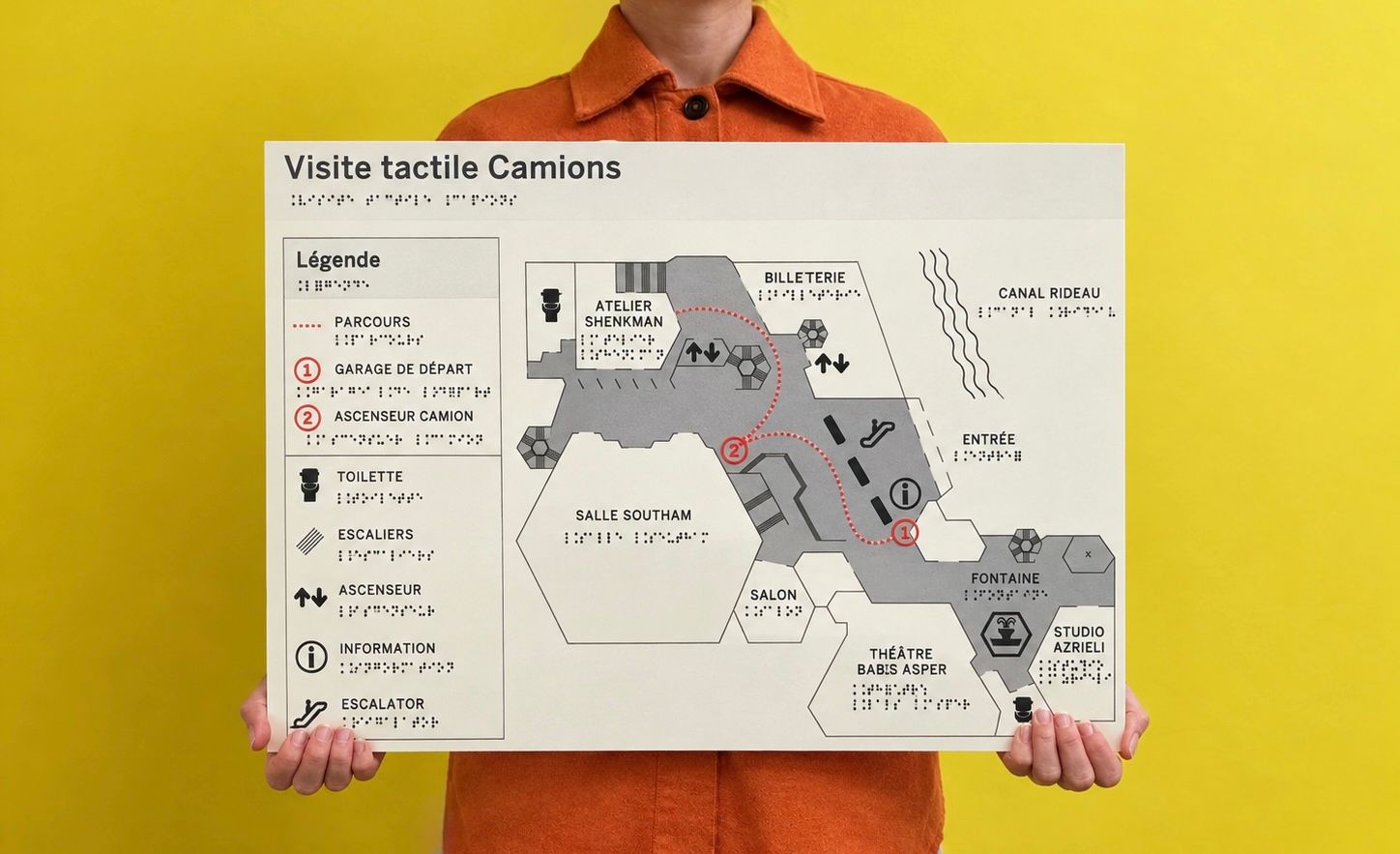
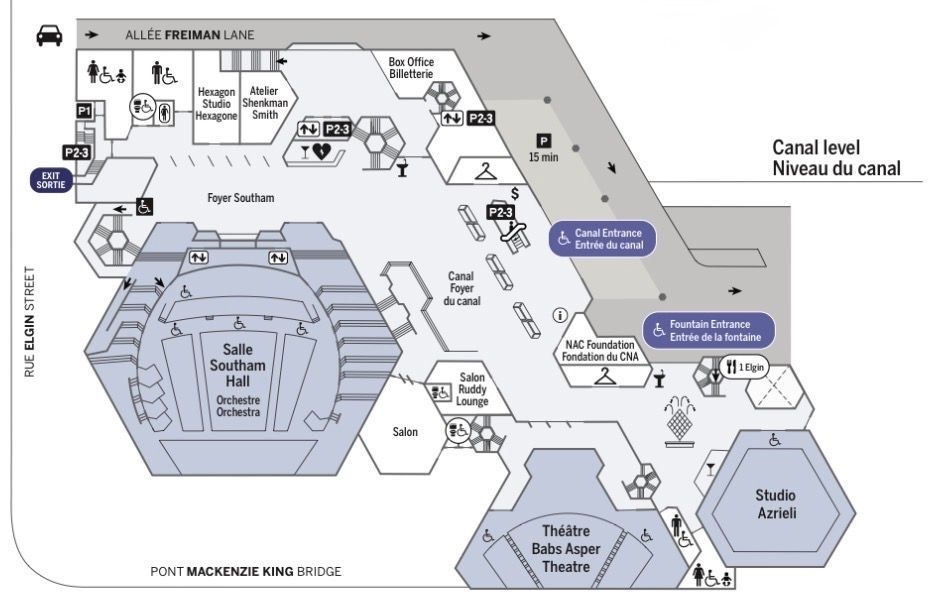
-
Wayfinding Sign along the route of "Camions," NAC
Tactile version / The original

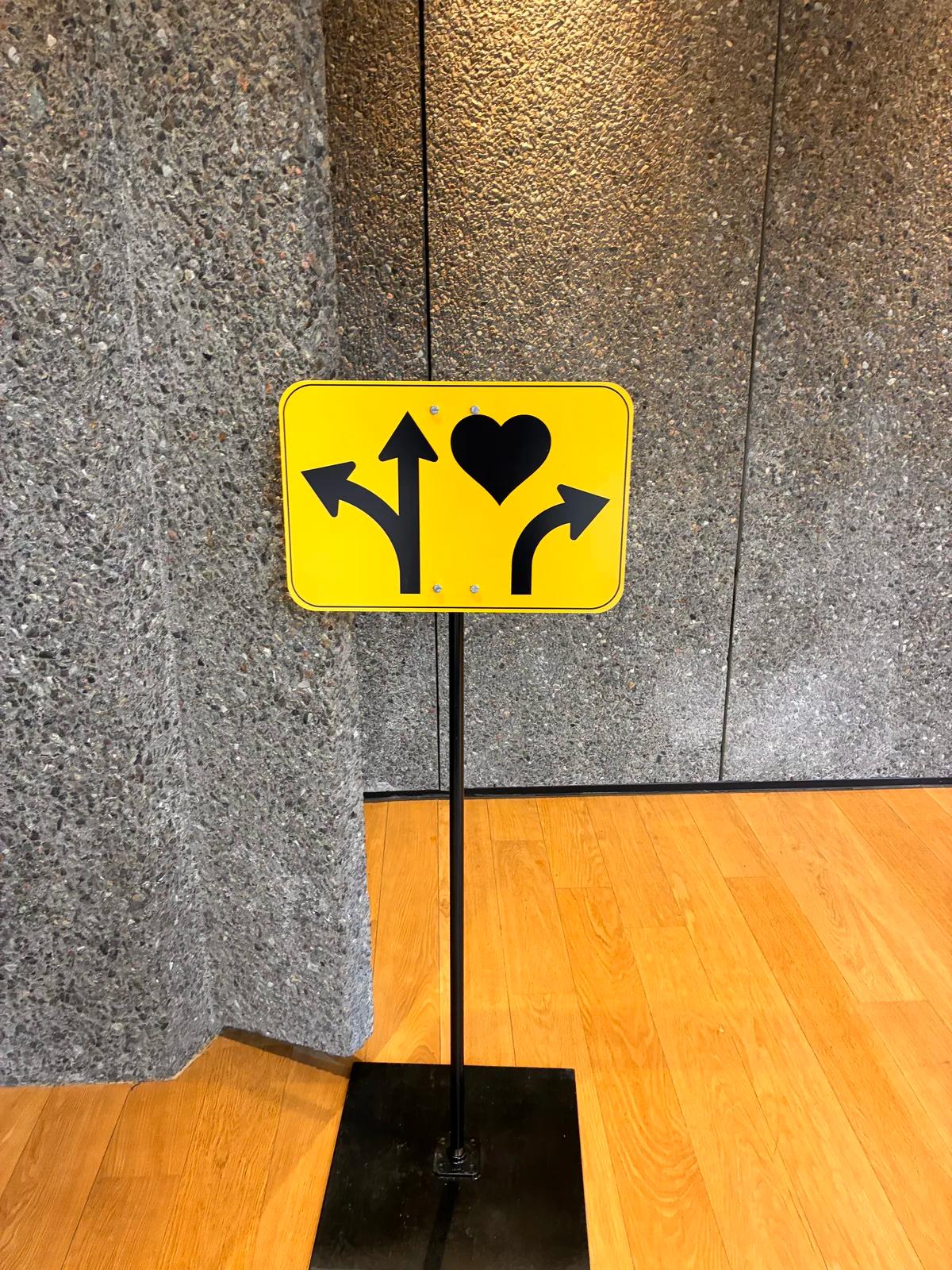
Tactile Graphic: Low Relief reproduction of Wayfinding sign for performance "Camions," approximately 12 x 8 inches.
See more See less
-
View from Last Stop of "Camions," NAC
Tactile version / The original
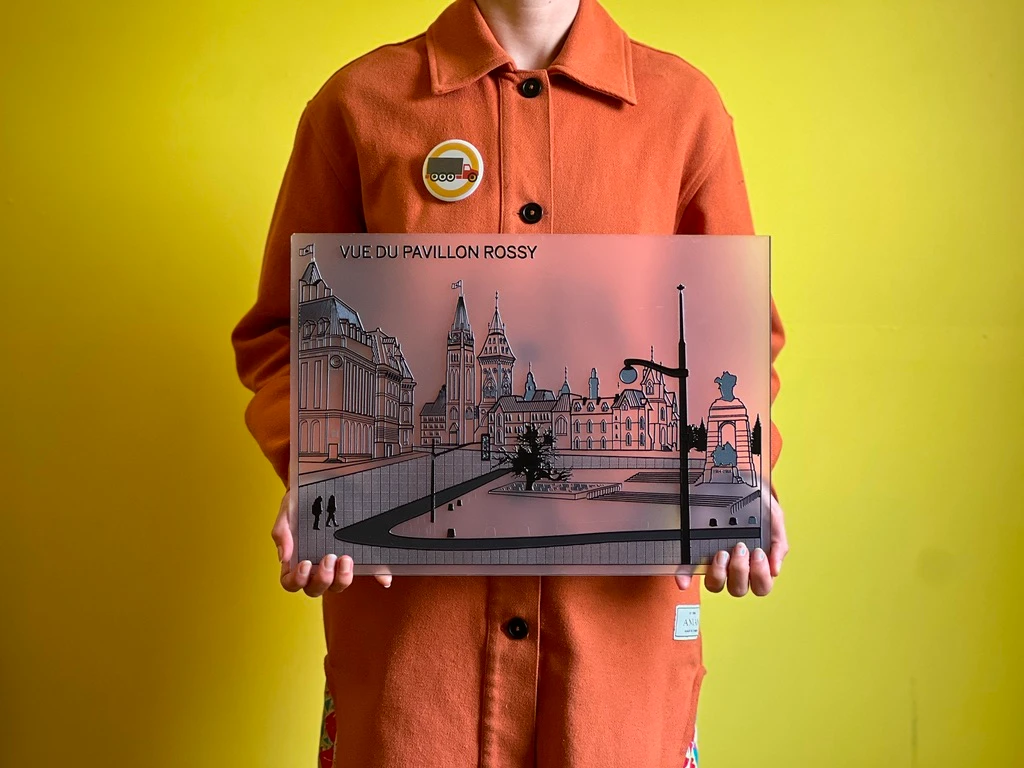
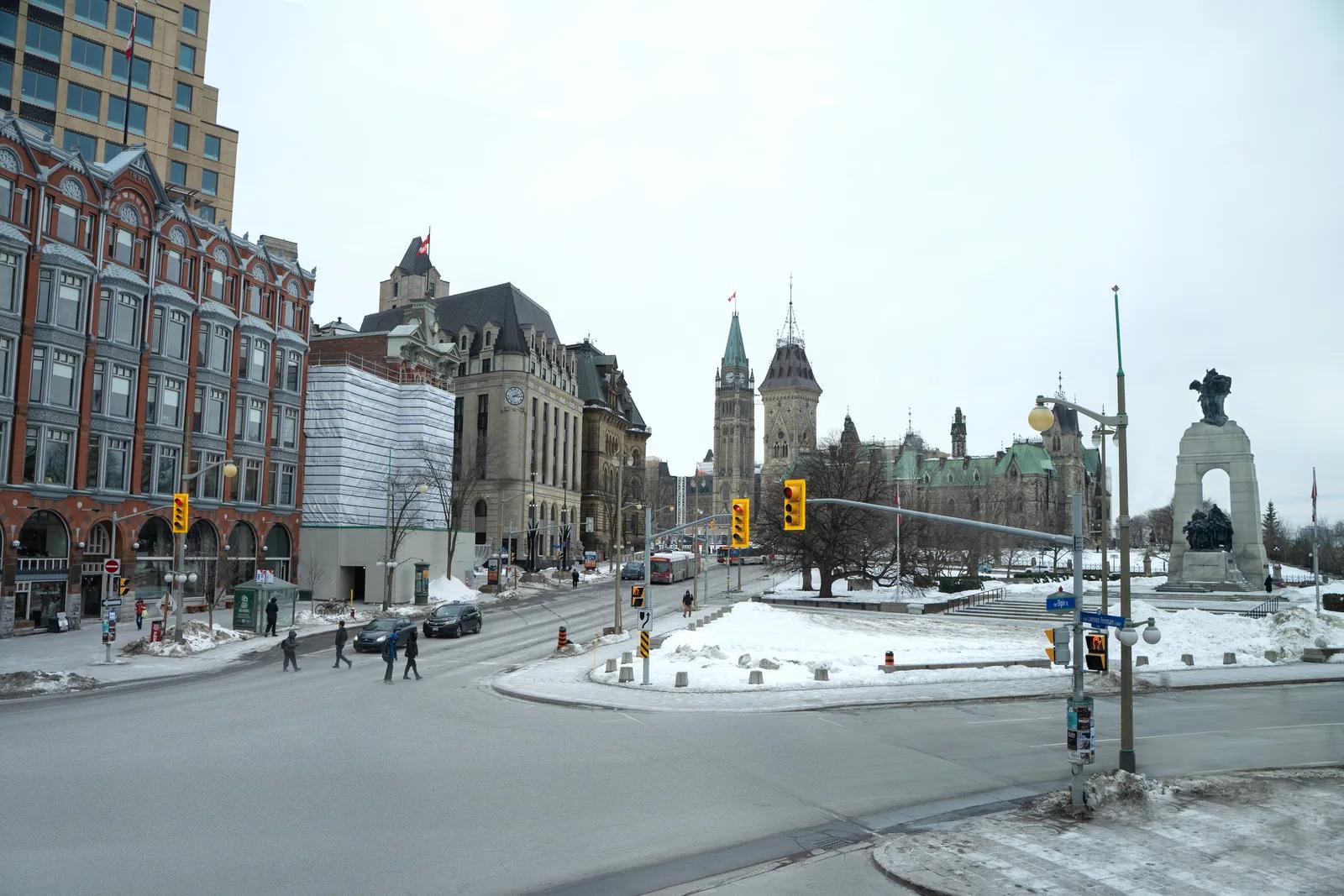
Tactile Panel: View from the Rossy Pavilion, National Arts Centre. Frosted plastic, 16.5 x 11.7 inches -
Public Art, NAC: Tapestry
Tactile version / The original
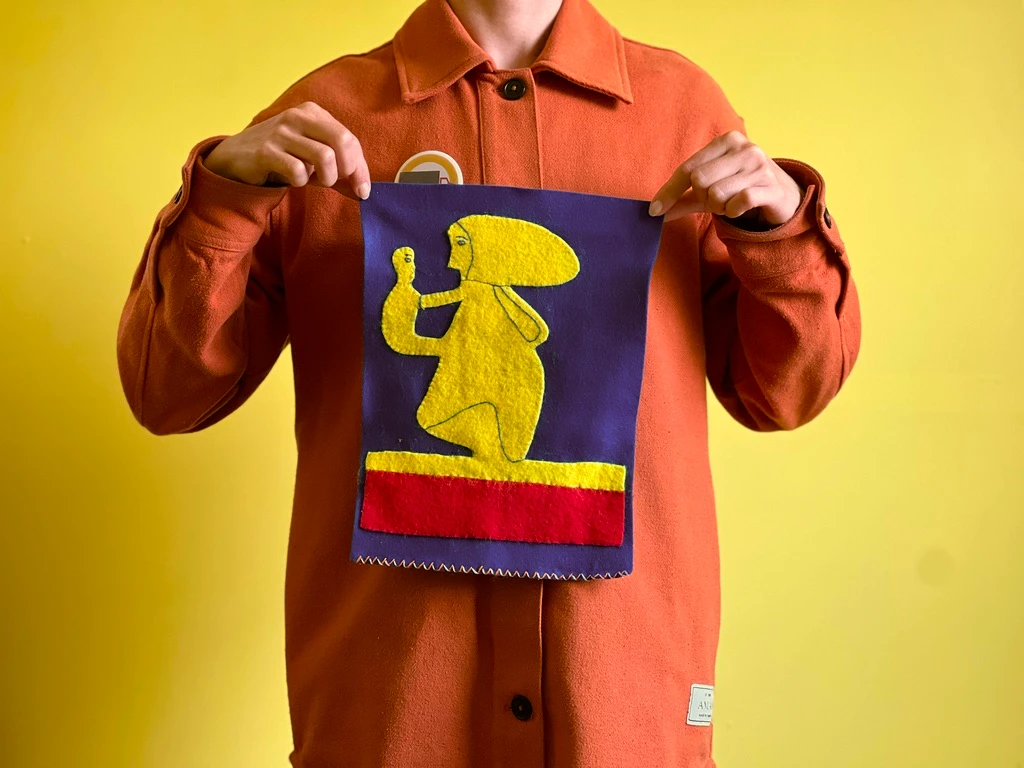
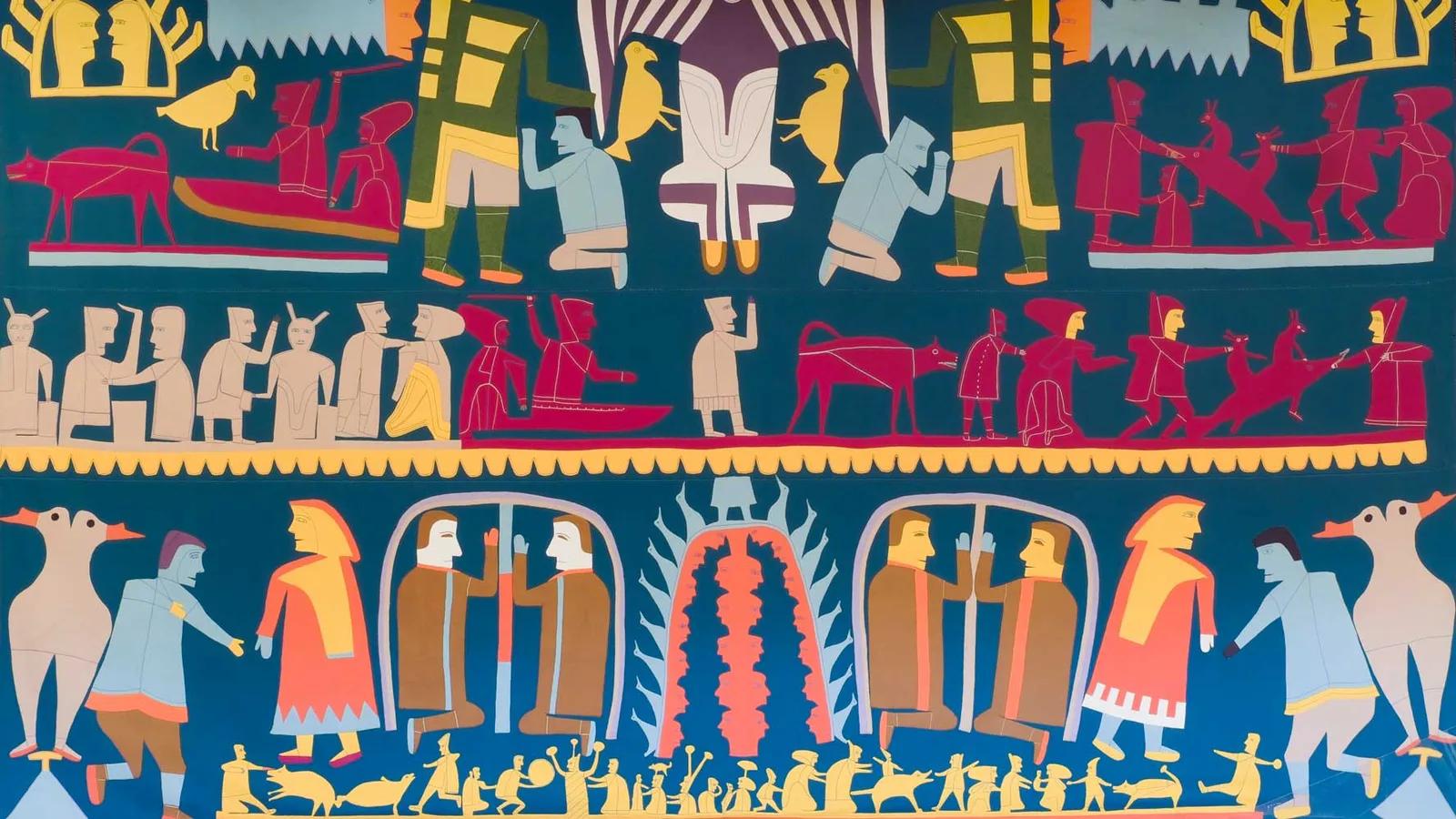
Tactile Reproduction of Detail from: Untitled Tapestry, Jessie Oonark, stroud with felt appliqué and embroidery floss, approximately 9.5 x 12.5 inches, 1972. -
Public Art, NAC: Canoe
Tactile version / The original
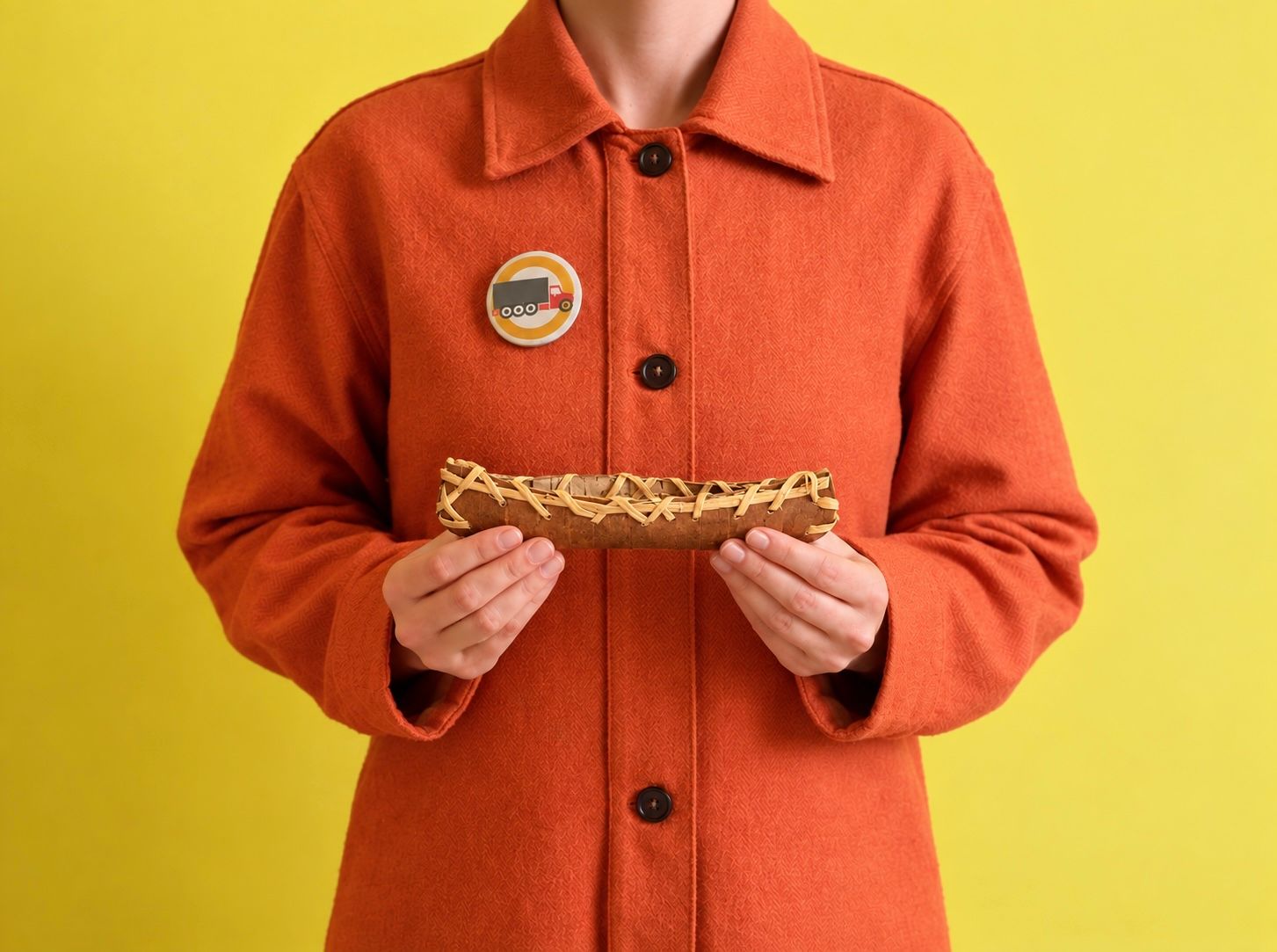
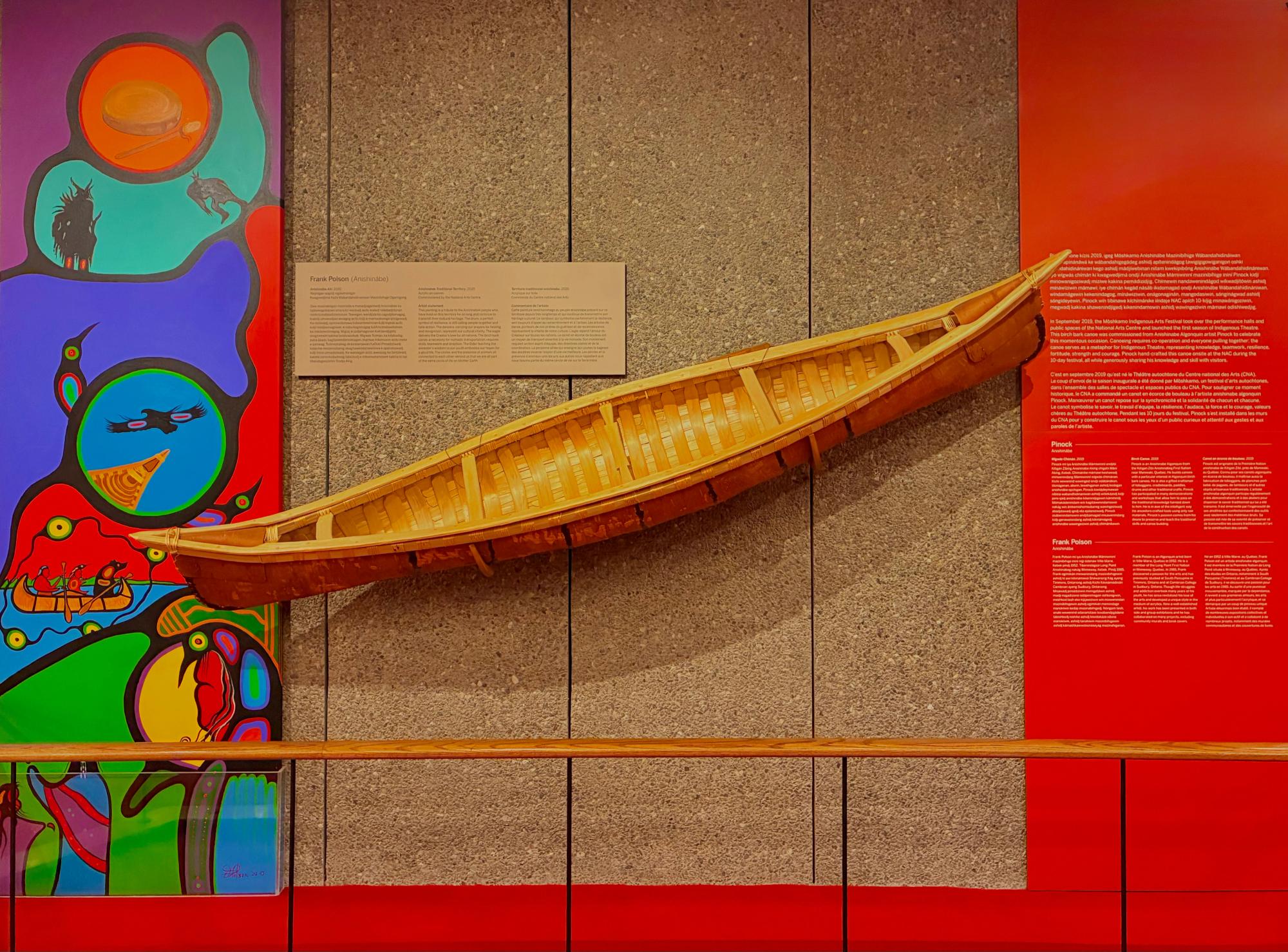
Birch Bark Canoe, Pinock -
Architectural Element, NAC: Original Ceiling Tile
Tactile version / The original
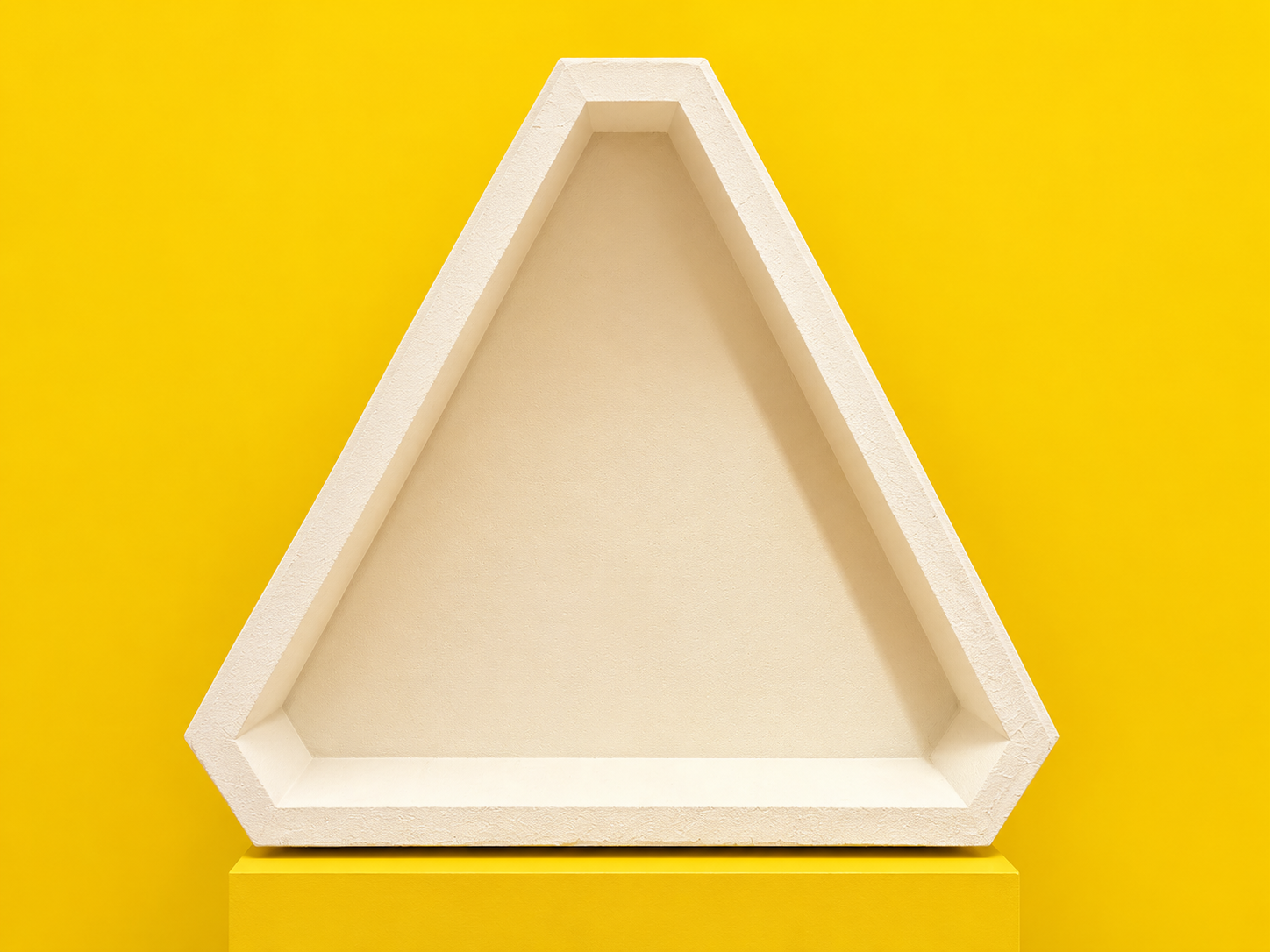
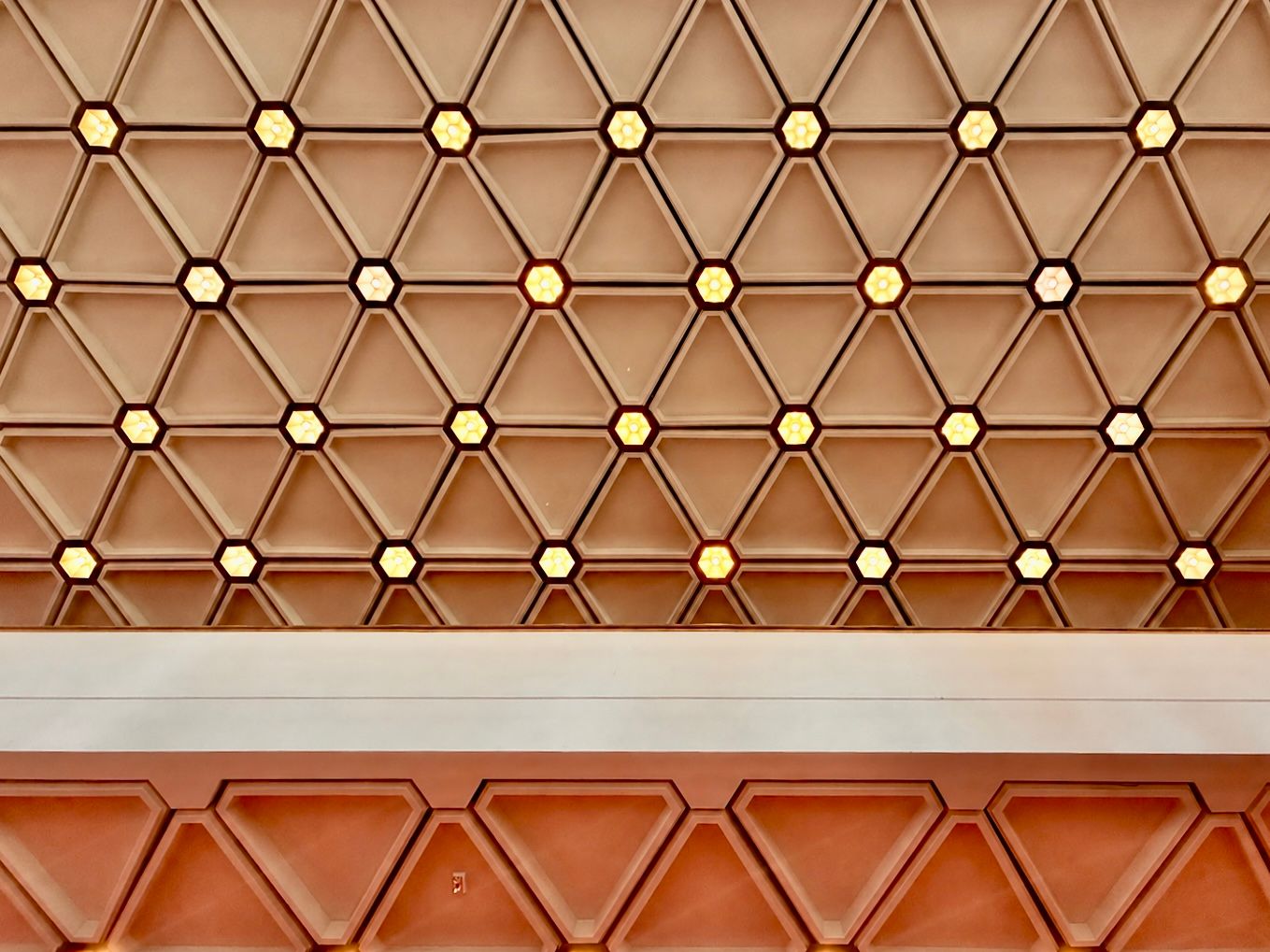
Ceiling, Southam Hall Foyer, National Arts Centre, Original 1969 Building. -
Station 1, "Camions" Tactile Tour: Truck and Truck Elevator
Tactile version / The original
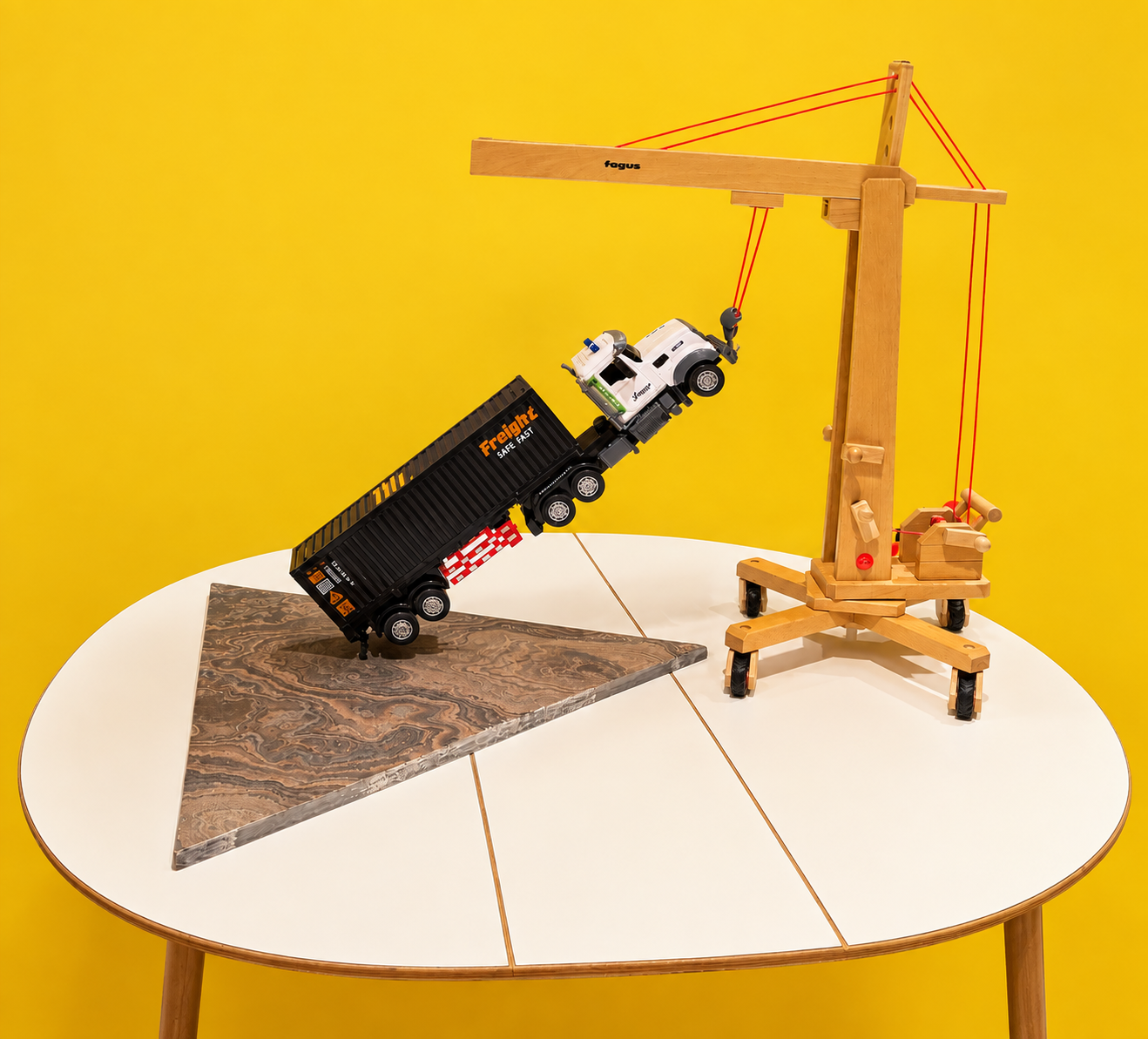
-
Station 2, "Camions" Tactile Tour: Cone Forest
Tactile version / The original

A
Get involved
Help shape the future of tactile art
We wish to spread this work to more institutions, more cities, and more people.
-
We're looking for galleries, theatres, and cultural institutions willing to host tactile exhibitions, pilot programs, or research residencies — in Canada or internationally. If you are an institution looking to get started with touch-based formats for the first time, we are happy to guide you through the best practises suitable to you.
-
Tactile Beauty is an evolving practice-based research project. Funding partners help cover materials, fabrication, travel, artist, consultant, and expertise fees. At the moment, we have applied at Canada Council for the Arts, Conseil des Arts et Lettres du Quebec, and have secured in-kind support from Canada National Institute for the Blind. Would you like to contribute as well?
-
From tactile graphics and Braille printing, to sensor-technology and 3D modelling, this project grows through collaboration. If you have technical or artistic skills to offer, we want to hear from you. If you are a professional artist or graphic designer wishing to expand your knowledge, we are happy to connect you with the best collaborator to refine your skillset.
-
Tactile Beauty is built with and for Blind and Low Vision communities. We're looking for BLV individuals to give feedback, test prototypes, and help guide the project as development partners — not just end users.
Interested in partnering with Tactile Beauty? Let's talk.
Get in touchAbout
Hi! I am Letizia, Creator & Lead Researcher of Tactile Beauty
Montreal-born, I am a cultural worker working across French, English and Italian. My experience brings together performance, cultural mediation and accessibility in an evolving practice focused on experiencing art beyond sight.
Previous collaborations and work experience in Montreal and Toronto include: MELS, Joe Jack et John, Superior Description Services, Danse-Cité, Luminato, Harbourfront Centre.

- National Arts Centre, Ottawa Project Lead, Tactile Tour, "Camions"
- National Gallery of Canada, Ottawa Museum Interpreter
- Danse-Cité/UQAM, Montreal; Cavazza Institute, Bologna Trained in live audiodescription, Shadowed tactile tours
- MELS Studios, Montreal Videodescriber
- McGill University, Montreal; Goldsmiths College, London UK BA, Art History, exchange in Bologna; MA, Performance Making
Read more
My training spans art history, physical theatre and performance. While working as a cultural mediator and videodescriber in Montreal, I trained in live audiodescription with Danse-Cité/UQAM in 2021. I have since delivered live and recorded audiodescription for theatre, performance and visual arts across cultural venues in Montreal, Toronto and Ottawa.
My longstanding relationship with Bologna began with an academic exchange over the course of my art history undergraduate degree. In 2023, as I was employed at the Education department of the National Gallery of Canada, I was introduced to best practices in tactile learning during a volunteer stay at the Cavazza Institute for the Blind in Bologna. Upon returning to the National Gallery, I co-led tactile tours as part of the gallery’s Wellbeing Programs in 2024. The same year, I began mentoring a Francophone audiodescriber at the National Arts Centre’s (NAC) Théâtre français, supporting the development of French-language audiodescription in the Canadian capital region. This is the collaboration that led me to develop the pilot project documented here, paving the way to Tactile Beauty.
Acknowledgements, Pilot Project
Many Thanks to the Following Organisations for their Support
-

National Arts Centre Venue -

National Gallery of Canada Lender, Miniature Birch Bark Canoe -

Terra Reproductions Specalized Printers -

MAD Servizi Culturali Consultants
Next Steps
The Timeline
Tactile Beauty began in Spring 2026 at the French Theatre of the National Arts Centre in Ottawa, Canada, with a first tactile rendering of a walking audio tour, entitled Camions, Fantômes de la liberté.
This Fall, Phase 2 will focus on tailored tactile guidance and audiodescription to explore photography, with partners Management Arts and Development Servizi Culturali, in Bologna, Italy.
In the Spring, as we are expecting responses around funding, our results will be shared at the Advanced Research Seminar on Audiodescription (ARSAD) in Barcelona, Spain.
-
Preliminary Steps
CompleteBologna, Italy
A first experience of tactile learning at the Anteros Museum in Bologna and the Omero Museum in Ancona, Italy.
Read more
With Loretta Secchi, director of the Anteros Museum of the Cavazza Institute for the Blind, I discovered various tactile translations in low relief. There I met the artists in charge of making the bas-reliefs, in plaster, according to the traditional techniques of the Renaissance. I go to the Omero Museum, where the director, Aldo Grassini, shows me the collection of sculptures and three-dimensional works that are entirely tactile.
-
-
-
Phase 1
CompleteCamions Pilot, National Arts Centre, Ottawa
A miniature tactile tour of the route of "Camions" along the National Arts Centre, in Ottawa.
Read more
In Spring 2026, the challenge of the NAC French Theatre was to create a version of Mélanie Binette’s Camions, Fantômes de la liberté (Trucks [Phantoms of Liberty]) accessible to francophone Blind and Low Vision audiences.
Stemming from the events of the 2022 trucker protests known as the “Freedom Convoy” in Ottawa, Mélanie Binette invited the public on an audio performance unfolding throughout the public spaces of the National Arts Centre. The journey culminated in a view of Parliament Hill, the site of the truckers’ protests, from the Rossy pavilion, one of the NAC’s glass-walled spaces.
The Tactile Version
The resulting tactile tour introduced Blind and Low Vision (BLV) francophone participants to the National Arts Centre’s architecture, its public art, and to Camions’ site-specific scenography.
By offering a miniaturized version of a journey spanning the indoor and outdoor spaces of the three-level building, it also allowed access to audiences with reduced mobility. The entire experience therefore took place within a studio located near the Camions meeting point, the so-called “Departure garage.”
In the studio, samples of architectural materials were placed on various tactile stations, including concrete with granite pebbles, lightweight fiberglass, polished limestone, and red carpet typical of formal events.
The NAC’s public art was illustrated by a miniature birch bark canoe, and a felt reproduction of a sample from a tapestry. Miniatures of site-specific installations included a wooden toy crane, plastic cones, and playful, reinvented traffic signs.
In particular, the offering featured a tactile photograph of a 1967 archival image, designed in Bologna by MAD Servizi Culturali and printed in Ottawa at Terra Reproductions.
Acknowledgements
Thank you to the six different departments of the National Arts Centre that have allowed me to offer this experience, to the creative minds from Le milieu de nulle part who have brought us the performance Camions (Trucks), to local Braille print services Terra Reproductions for their willingness to try something new, and to the National Gallery of Canada’s Educational Department for making it possible to touch a miniature canoe.
Above all, I would like to thank Management Art and Development Cultural Services (MAD Servizi Culturali) in Bologna for sharing invaluable knowledge and for acting as an external eye in this pilot. I look forward to renewing our collaboration over the next phase of Tactile Beauty.
-
Phase 2
In progressKnowledge Exchange, MAD: Bologna, Italy & ARSAD: Barcelona, Spain
An in-person encounter with MAD Servizi Culturali in Bologna to discover various modalities of tactile translations of photography.
Read more
In Fall 2026, Tactile Beauty travels to Bologna to meet partners MAD Servizi Culturali and La Girobussola at Fondazione MAST. Opened in 2012, the Fondazione welcomes photographic exhibitions on the theme of work and labour.
Looking at tactile panels previously developed around the work of Canadian photographer Jeff Wall and German photographer Bernd and Hilla Becher, we exchanged in person around various supports used for tactile printing, and potential training in order to design a tactile photography directly in Canada.
We also discussed exploring recorded, tailored tactile guidance and audiodescription to support autonomous visit outside of tactile tours facilitated by cultural mediators.
In Spring 2027, Letizia travels to the bi-yearly Advanced Research Seminar in Audiodescription (ARSAD) in Barcelona to present Tactile Beauty. This year will focus on co-creating the future of audiodescription.
-
-
-
Phase 3
ExploratoryNext Steps: International Exchange & Local Collaborations
New tactile prototypes with local artists, technologists and Blind and Low Vision consultants, and research partnerships with universities.
Read more
From Spring 2027, Phase 3 turns to Canada's own path toward accessible design, developing new tactile prototypes with local artists and technologists. It also includes the support of Canadian National Institute for the Blind (CNIB) in creating a Blind and Low Vision focus group to test outcomes.
We are currently pursuing funding opportunities to continue bringing knowledge from Italy and abroad into the Canadian context, as well as actively seeking collaborations with universities and academic researchers to test prototypes before making them available to the public.
Ultimately, the integration of tactility in the arts aims to move beyond the tactile translation of an original work towards tactile expression and aesthetics. Rather than treating tactility solely as a means of improving accessibility, Tactile Beauty asks whether it might become an emerging artistic practice in its own right—inviting artists, researchers and institutions to explore its possibilities together.
-
-